SEO for Tree Services and Arborists: A Safe Guide
Build useful pages from real tree and property tasks, checked crew facts, exact local details, safe work limits, fair proof, quote terms, and crew capacity.

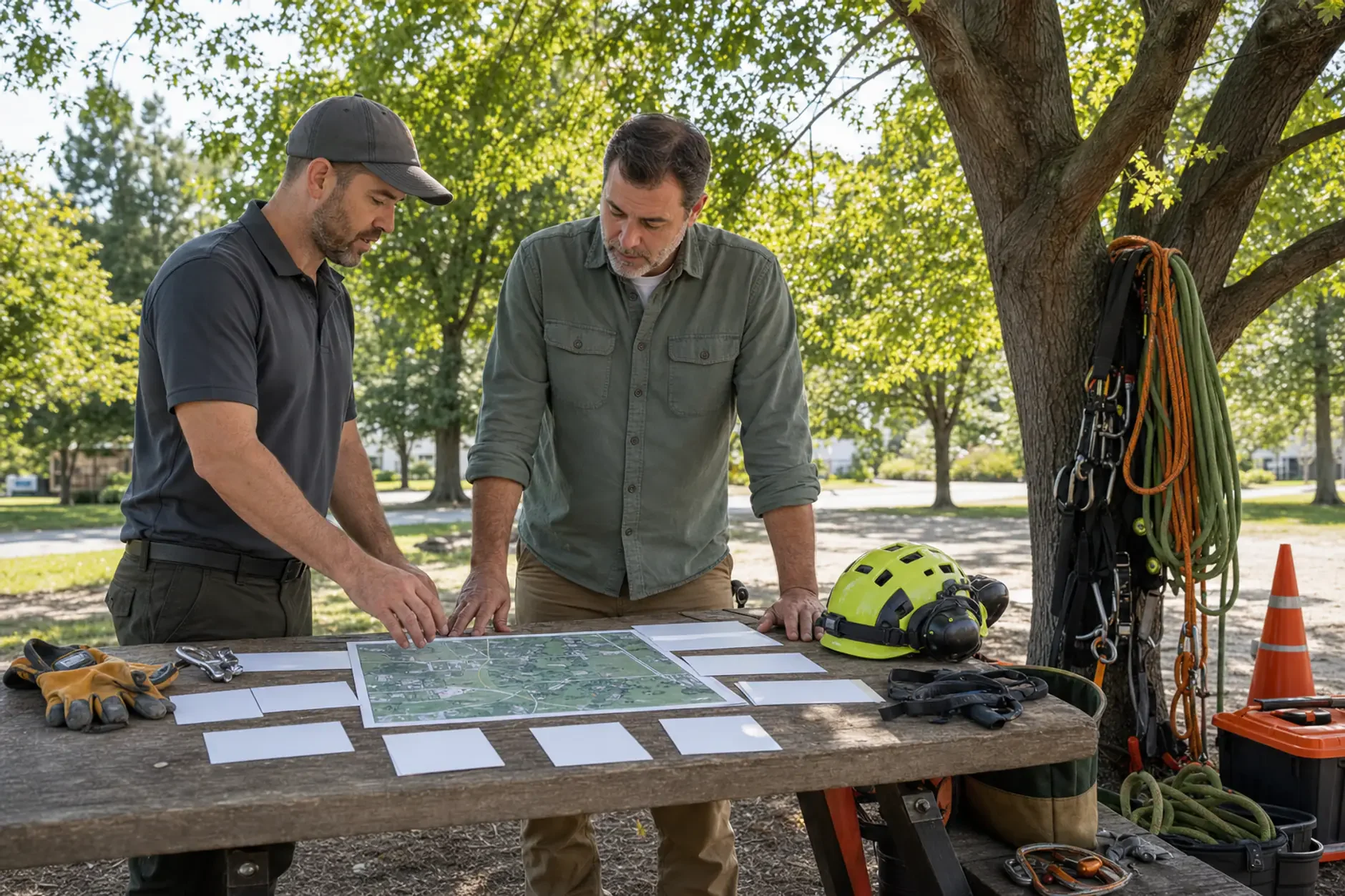
SEO for a tree service has one job. It should help a property owner check the work scope. It should also show arborist or crew facts, site limits, safety, service area, hours, quote terms, and the next step. A storm or a first rank cannot promise a call, a visit, a job, a safe tree, market share, or return.
Start with the real company. Check each license or registration where one is required. Check each service, arborist claim, and crew skill. Then check the insurance fact, area, hour, safety limit, price fact, open slot, and contact route. Give each key fact an owner and a review date.
Separate Planned, Urgent, and Advisory Tasks
Planned work may include a tree check, pruning, removal, stump work, planting, support, or plant-health care.
Urgent work may involve storm damage, a fallen limb, or blocked access. It can also mean another risk that needs safe triage.
Advice may cover tree condition or site fit. It may cover local rules or ownership. It may cover permits, protected trees, or utilities. Or it may mean a hand-off to another expert.
Each page should state what the company can do and where. It should also give the hours, the limits, and the contact route.
Do not diagnose a tree or promise that it is safe. Do not tell an untrained reader to cut, climb, or move a limb. The same goes for entering a drop zone or working near a line. Route fire, live-wire, road, building, gas, flood, and other urgent risks to the right emergency owner.
Map Demand Without Predicting a Storm or Season
Demand can change with weather, climate, and tree types. Local rules, property work, budgets, crew size, and referrals move it too. Use current search, call, quote, job, and weather data. Look at capacity data as well. Do not assume every market has a spring spike or weak competitors.
Create a page when the service is real and the property task is distinct. Do not make one thin page for every tree type, symptom, storm, town, or housing area. Update or remove time-bound pages when the facts no longer help.
Keep Local Profiles and Service Areas Exact
Use the real-world business name. Pick the fewest true categories. Show an address only when it is eligible and staffed as required. Keep service areas, phone, site, and hours current. Keep the owner and manager list current too. Do not use virtual offices to look closer to a property. Do not set up duplicate profiles either.
State the places the crew can truly serve. Note any travel or access limit. A broad service area does not prove a quick visit. It does not prove permit scope. It does not prove emergency cover or crew capacity.
Keep Arborist, Safety, and Tree Claims Narrow
Check each arborist title, license, training, insurance fact, and trade membership. Use the right owner and a public source where that helps. State the place, the scope, and the date. One badge does not prove tree condition, site safety, craft, price, or a result.
OSHA lists falls, falling objects, lifts, power lines, tools, traffic, and other risks in tree work. The company safety owner must set the real site plan. That covers crew, gear, drop zones, line controls, and stop-work rules. A marketing page is not a work plan.
Use Project Proof and Reviews Fairly
Use site photos only with rights and consent. Hide names, addresses, faces, plates, and access points. Hide utility details, nests, disputes, and private damage too. Do not present stock or made-up work as a client job. One image cannot prove tree health, risk, ownership, safe work, or a result.
Ask real clients for honest reviews. Do not buy praise or gate criticism. Do not reward only good comments. Never script a risk or safety claim. A public reply should not reveal a property, a neighbor dispute, or an insurer. It should not reveal damage, injury, price, or a private service fact.
Make Calls and Quotes Safe
Ask only for facts needed to route the work. Keep gate codes, tenant facts, IDs, and payment data private. The same goes for exact risks and private site details. Keep them out of URLs, ad lists, public chat, and unapproved tools. State that a form is not dispatch or a booking.
Explain the first call, safe site access, and the assessment. Then cover the written scope, quote, and approval. Cover permits and utility checks too. Finish with changes, cleanup, payment, and follow-up. Say what can change price or time. Do not promise arrival, approval, safe trees, no damage, or a finish date.
Measure Fit and Crew Capacity
Track correct profile and service facts, valid pages, useful calls, and safe forms. Track wrong-area or wrong-scope contacts too. Then track site visits, quotes, and approved work. Track changes, cancellations, complaints, and crew load where lawful.
Compare like periods. Note storms, weather, staff, prices, ads, referrals, rules, and work mix. A rank, review, call, visit, quote, or short test cannot prove that SEO caused a job. It cannot prove a safe tree, revenue, market share, or return either.
For profile basics, use the local SEO guide.
For a related property workflow, read the roofer SEO guide.
For work and result timing, see the first-year SEO timeline.
A Fast Release Check
Are services, qualifications, insurance facts, areas, hours, safety limits, quote terms, and open slots current? Are photo rights on file? Are urgent routes clear? Is the form private? If not, hold the page.
The Practical Rule
Build tree-service SEO around real scope and safe triage. Add checked crew facts, exact local details, and narrow risk claims. Add fair project proof, clear quote terms, private forms, and crew capacity. Help an owner take the next safe step. Do not promise rank, calls, jobs, safe trees, share, or return.
This is broad marketing help. It is not arboriculture, plant health, tree risk, utility, or weather advice. It is not worker safety, insurance, code, contract, or legal advice. We checked the cited U.S. OSHA, FTC, and Google pages on 16 July 2026. Rules and company facts can change. Use current local rules and skilled advice.
Need a safer search plan for a tree service?
TTGC can check service pages, local facts, credentials, safety limits, proof, reviews, private calls, quote terms, measurement, and crew load. Tree, utility, safety, insurance, code, contract, and legal choices stay with skilled owners. Rankings, timing, calls, visits, jobs, tree results, and return are not promised.
Sources
- Google Search Central: People-first content. It covers useful work, trust, writers, sources, skill, and search raters. Checked 16 July 2026. https://developers.google.com/search/docs/fundamentals/creating-helpful-content
- Google Business Profile rules. Use a real name and valid site or service area. Keep hours, categories, owners, and key facts true. Checked 16 July 2026. https://support.google.com/business/answer/3038177?hl=en
- Federal Trade Commission: Endorsements, Influencers, and Reviews. Reviews must be honest. Key ties must be clear. A business must not hide fair criticism or fake feedback. Checked 16 July 2026. https://www.ftc.gov/business-guidance/advertising-marketing/endorsements-influencers-reviews
- Federal Trade Commission: How to avoid a home improvement scam. Check licenses and proof of cover where required. Use written bids and terms. Checked 16 July 2026. https://consumer.ftc.gov/articles/how-avoid-home-improvement-scam
- U.S. OSHA: Tree Care Industry. It covers tree-care services, hazards, safety programs, standards, and current worker resources. Checked 16 July 2026. https://www.osha.gov/tree-care/
- U.S. OSHA: Tree Care Industry Standards. It links current rules and references for lifts, protective gear, power, training, hazardous materials, and other covered work. Checked 16 July 2026. https://www.osha.gov/tree-care/standards
Want hands-on help with this? Explore our SEO service.