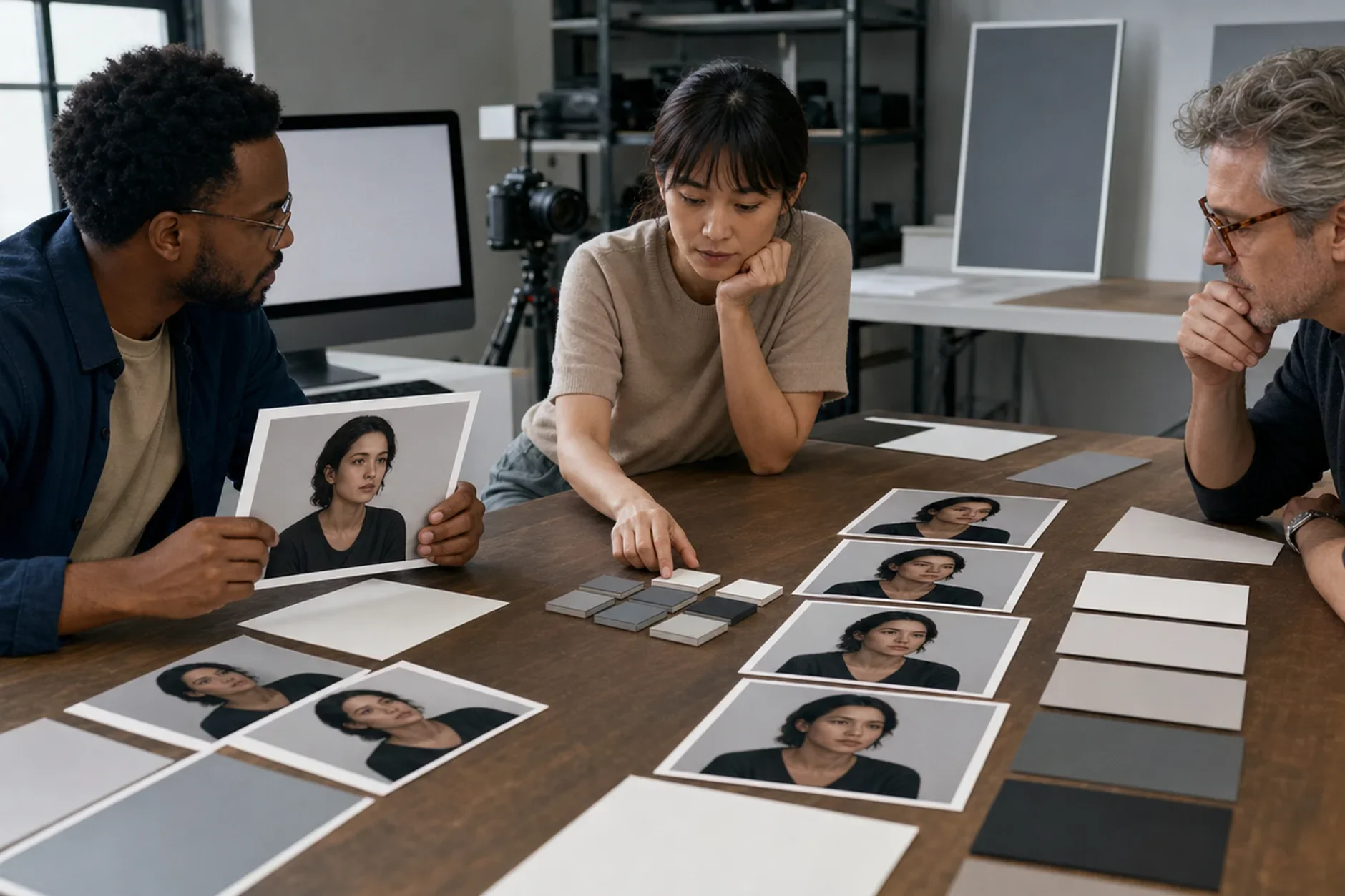
The Best Way to Brief Your AI Avatar
A well-structured brief is the difference between an avatar that represents your brand and one that looks like a polished stranger. Here's the briefing framework we use.


Most people underestimate what a good AI avatar brief takes. They treat it like a stock photo search. Type a few words, scroll the results, and pick one that is close enough. But the two tasks are not the same. A stock photo search is retrieval. You find something that already exists. An AI avatar brief is generation. You describe something that does not exist yet. The quality of your description decides the result. A clear brief gets you something useful. A weak one means you regenerate it forty times.
The best briefs are not long. They are structured. They answer a few questions in a set order. Each answer steers the result in a useful way. The worst briefs go one of two ways. Some are too vague, like "professional, approachable, modern." Others pile on conflicting detail that the model has to average out. A good brief is not about writing more. It is about writing the right things in the right order.
The Brief Has Four Layers - Most People Only Do Two
A complete avatar brief covers four layers. First is physical identity. That means what the person looks like, in detail. Second is context. That means the setting and the occasion for the avatar. Third is brand alignment. That means the visual language that ties the avatar to your brand. Fourth is emotional register. That means what the person should get across to the viewer. Most people nail layer one. Then they wave at layer four in a vague way. Layers two and three are where brand-ready avatars get built.
Layer 1 - Physical: the age range, the features, the hair, the complexion, and the build. Be as specific as you can here, not categorical
Layer 2 - Context: where will this be used? On a white background for a website? In an environmental shot for a LinkedIn header? Each use case needs its own set of generation parameters
Layer 3 - Brand: what colors, what wardrobe, and what visual tone line up with the brand identity you have?
Layer 4 - Register: what is the emotional note? It could be authority, warmth, curiosity, or calm confidence. Name the exact one that you want
Write the Context Before the Appearance
Here is one tip that reliably lifts brief quality. Write the context layer first, not last. Say you start like this: "This avatar will be a speaker bio photo on a conference website for enterprise procurement teams." Now the rest of the brief lines up. The wardrobe, the background, and the formality of the expression all follow from that use case. Start with appearance instead, and you add context at the end. That context often clashes with the looks you already chose. The model then makes something that looks good but feels wrong for the job.
Brand Alignment Is a Visual Specification, Not a Mood Board
Telling the model "this should feel consistent with our brand" does not help it. A useful brand alignment brief looks like this: "Our brand palette centers on deep forest green and warm off-white. Wardrobe should lean toward those tones - think dark green jacket or blazer over a neutral base. Avoid bright colors and heavily saturated backgrounds. Typography in our brand is clean and modern, so the overall image should feel considered and uncluttered." The model can work with a brief like that. A mood board helps you get clear in your own head. But the prompt needs that board turned into parameters it can act on.
How Kyndrify Turns Your Brief Into a Reusable Configuration
A four-layer brief is useful once. The problem is that a raw text brief does not travel well. It breaks down as different people read it different ways. Or it gets trimmed to "save time" in the next session. Kyndrify fixes this by design. Its button-based framework maps your brief parameters to model inputs. That mapping holds from one session to the next. You build the brief once, and the setup is saved. Every later generation starts from that spec, not from scratch. For teams and agencies, the brief becomes a shared asset. It does not sit in someone's Notion page and get ignored.
A good brief is upstream work. It makes everything after it faster and more consistent. Spend fifteen minutes on a full four-layer brief. It pays you back in fewer regeneration cycles and less client revision. You also get an avatar that fits its context. Treat briefing as the craft it is. It is not a chore between you and hitting generate.
Sources
TTGC / Kyndrify - the patterns we see as we build AI avatar tooling.
Content Marketing Institute - research on what makes a creative brief work. See it at contentmarketinginstitute.com
Ready to work with Through The Glass Creatives?
Book a free Brand and Growth Assessment and see exactly how Mherie, Ravve, and the TTGC team would approach it.
Related reading: How to Make an AI Avatar That Matches Your Brand Voice · The Framework That Makes AI Avatars Actually Repeatable