What Is a Brand Archetype?
Understand how archetype frameworks can organize a brand story, where they fall short, and how to use them without forcing a stereotype.

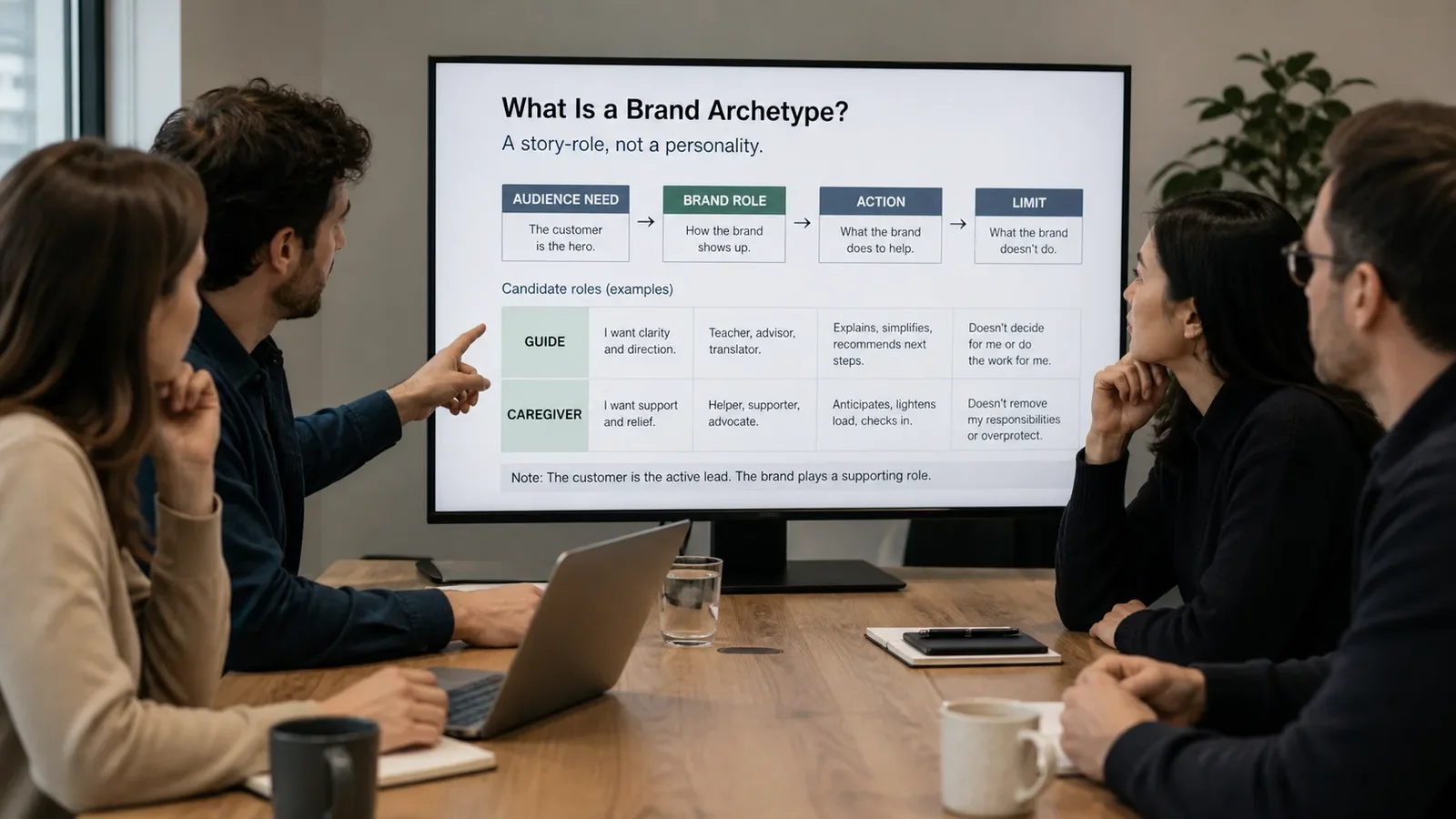
A brand archetype is a recurring story role used to organize a brand’s character, motives, symbols, and narrative. Common commercial frameworks use labels such as caregiver, explorer, creator, or hero to help teams find a consistent story pattern.
Archetypes are interpretive tools. They are not laws of psychology, fixed identities, or proof that all people share one response. Research on their use in branding is still developing, and common twelve-part lists come from specific authors and practices.
Put It in Plain Words
Stories often use roles people can spot. One character protects. One explores. One teaches. A brand team can use a similar role to guide how it speaks and acts.
The role should come from the work and the audience need. A health service should not choose “hero” only because it sounds strong. It may place the company at the center when the patient should be the main actor.
Use the model to ask questions. What does the brand seek? What conflict does it help with? What does it fear? What behavior would break the role? The answers matter more than the label.
Check cultural meaning. A symbol, myth, or role can carry different meaning across places and groups. Do not treat one Western framework as universal.
Allow more than one facet when evidence supports it. A brand can teach in one moment and care in another. The system should explain the pattern rather than force every message into one box.
Test real samples without showing the archetype name. Ask people what role the brand seems to play and why. If they cannot see it, fix the experience or retire the model.
Start with a true story from the brand. Note who had a need, who gave help, what stood in the way, and what changed. Do not add a myth yet.
Read the story as a group. Ask which role the brand played. Ask if that role was useful. Ask if the customer still had a real choice and a clear part.
Make one small ad and one service note with the role in mind. Hide the label. Show the work to new readers and ask what they think the brand is trying to do.
If the role only works in the ad, stop. A good lens should fit the product and the way the team acts. It should not be a mask for the sale.
How Does Brand Archetype Work?
The team reviews the offer, purpose, audience research, brand history, stories, symbols, and behavior. It compares those facts with a chosen archetype framework and uses the closest role as a creative lens.
The lens can guide narrative, voice, image choice, partnerships, and experience. It should remain subordinate to evidence, ethics, accessibility, legal review, and the real product. The framework does not excuse a false claim or copied culture.
Why Is It Important?
An archetype can give writers and designers a shared story shape. It can also reveal when a brand casts itself in the wrong role or makes the customer a passive extra.
The model becomes weak when it replaces research, reduces people to myths, or makes every brand look the same. Use it as one optional tool and state which framework you chose.
Where Is It Used?
Narrative strategy, campaigns, naming, visual direction, and creative briefs.
Reviews of the role played by the brand, customer, guide, rival, and community.
Workshops that compare possible story systems before testing real work.
A Simple Brand Archetype Example
A public library may test a guide or sage role. The useful expression could be clear paths, trusted sources, patient help, and open access. The library should not claim to know everything or speak down to readers.
The same facts may support an explorer role for a children’s program. That does not require changing the whole institution. It shows why context and hierarchy matter.
What Should an Archetype Brief Include?
The exact framework and source being used.
The role, motive, conflict, and useful promise.
Observable behaviors and story patterns.
Symbols and language that fit without copying culture.
The customer’s role and degree of agency.
Limits, cultural review, and situations where the model should not apply.
How Do You Choose One?
Start with audience, offer, purpose, and behavior evidence.
Compare more than one possible story role.
Define the benefit and risk of each role.
Create small unbranded samples.
Test perception across relevant groups.
Keep, blend, or reject the model based on evidence.
Brand Archetype vs. Brand Personality
An archetype is a recurring story role with motives and narrative patterns. Brand personality is a set of human-like traits people associate with the brand. A caregiver archetype might feel warm and steady, but those traits do not define every caregiver story.
A buyer persona is different again. It is a research model of a customer type. Do not assign customers an archetype and assume it predicts how each person will act.
Common Mistakes
Treating a twelve-part list as a universal scientific fact.
Choosing the most dramatic label instead of the best fit.
Forcing all audiences and products into one role.
Borrowing sacred or cultural symbols without context or permission.
Making the brand the hero when the customer needs agency.
Frequently Asked Questions
How many brand archetypes are there?
There is no single official count. Popular brand frameworks often use twelve, while research and practice use other structures. Name the source and avoid presenting one list as universal.
Can a brand use two archetypes?
Yes, if the relationship is clear and tested. One may be primary and another may describe a context or sub-brand. Do not blend labels only to avoid making a choice.
Are brand archetypes scientifically proven?
They are used in research and practice, but evidence and definitions vary. Treat them as interpretive frameworks, not as a diagnosis or guaranteed response.
Ground the story in a clear Brand Positioning Statement and make sure the expression supports the real offer with Marketing Can’t Fix a Bad Offer.
Need a story framework that stays grounded in evidence?
Book a free Brand and Tech Assessment to map the current problem, evidence, constraints, and practical next step.
Sources
- University of Washington: Brand Archetypes dissertation. https://digital.lib.washington.edu/researchworks/items/c15713ba-a19c-4da6-9ca8-2758d42560e1
- Business Horizons: Exploring the changing role of brand archetypes. https://www.sciencedirect.com/science/article/pii/S0007681322001355