What Is a Unique Selling Proposition?
Learn what a USP says, how it differs from a value proposition and slogan, and how to test whether the claimed difference matters.

A unique selling proposition, or USP, is a focused reason offered to a customer for choosing one product, service, or brand instead of a relevant alternative. It links a meaningful difference to a benefit and a claim the seller can support.
The idea is associated with advertising executive Rosser Reeves. Modern teams use the term in several ways, so the brief should define it. A USP is not a slogan, a list of features, or proof that no competitor can ever make a similar claim.
Put It in Plain Words
A buyer has choices. They may choose you, pick another route, do the work alone, or wait. A USP says why your route may fit one important need better.
Start with the buyer’s task. A feature is not useful only because it is rare. It needs to help with a problem, limit, risk, speed, cost, access need, or desired result.
Check the market. A claim can sound unique inside the company while every rival says the same thing. Read offers, reviews, customer calls, and loss notes. Look for a difference that is both real and useful.
Add proof. A live feature, process, standard, qualification, policy, demo, or checkable fact can support the claim. Do not use “only,” “best,” or “guaranteed” unless a qualified review confirms the claim.
Keep the claim narrow. One strong reason is easier to grasp than ten weak points. The full page can explain who it fits, how it works, and where the limit sits.
Test the USP with the right people. Ask what they think the offer does, why it is different, and what proof they need. Their answers show whether the statement is clear.
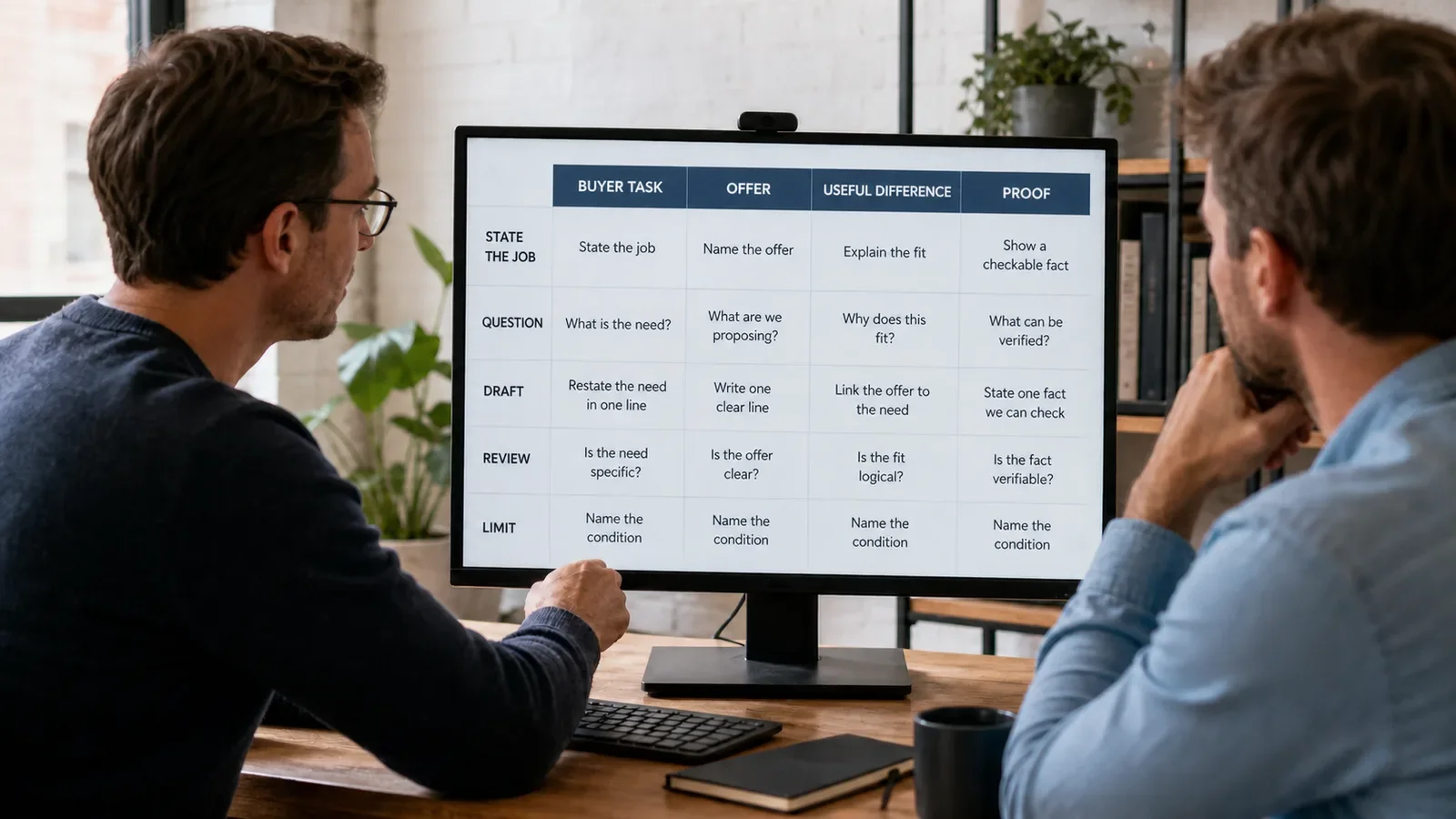
Use a four-box test. In the first box, write the buyer and task. In the next, write the offer. Then write the useful change. Last, write the proof.
Read the line with no brand name. Could a rival say the same thing? If yes, make the fact more clear or choose a new point. Do not add a loud claim.
Show the proof near the line. A person should not have to hunt for a key term, limit, or fee. Clear proof makes the choice fair.
Check the claim once the work starts. If the team cannot keep it, fix the work or stop the claim. A short line is still a promise to the buyer.
How Does Unique Selling Proposition Work?
The team studies customer needs, alternatives, market claims, product facts, service evidence, and reasons for wins and losses. It selects one relevant difference, writes several plain versions, and checks each one against evidence.
The chosen USP can guide a headline, ad, pitch, product page, or sales answer. The product and service must keep the claim after the click. A message cannot create a difference that the offer does not provide.
Why Is It Important?
A clear USP can make comparison easier and stop a page from sounding like every competitor. It can also focus product and sales teams on the difference they need to maintain.
A weak USP can mislead customers or push the team toward an irrelevant novelty. Use truth, fit, and evidence before clever wording.
Where Is It Used?
Landing pages, product pages, ads, proposals, pitches, and sales enablement.
Offer design, market reviews, creative briefs, and competitor comparisons.
Short messages that lead to a fuller proof path.
A Simple USP Example
A bookkeeping service for restaurants might say it closes weekly books from the point-of-sale and payroll systems without asking the owner to rebuild each file. The useful difference is the specific workflow, not a vague claim to be “better.”
The service would still need to prove which systems it supports, what the owner must supply, how errors are handled, and what “weekly” means. The example is hypothetical and promises no result.
What Should a USP Include?
A specific audience or use case.
A meaningful customer need.
The offer and relevant difference.
A useful benefit linked to that difference.
Proof, conditions, and limits.
A comparison set that makes sense.
How Do You Write and Test a USP?
Interview customers and review alternatives.
List useful differences and evidence.
Remove claims that are common, weak, or hard to prove.
Write one clear proposition in several forms.
Test meaning and credibility with intended buyers.
Check the live experience keeps the promise.
USP vs. Value Proposition
A value proposition explains the value an audience may receive and why the offer fits. A USP stresses a distinct reason to choose the offer over a relevant alternative. A value proposition may contain a USP, but it can still be useful when the advantage is fit rather than a unique feature.
A slogan is a short memorable line. It may express the USP, but it can also carry a theme or voice. A tagline without proof is not a selling proposition.
Common Mistakes
Calling a generic strength unique.
Choosing a difference customers do not value.
Using a superlative with no support.
Writing a slogan before studying the offer.
Ignoring a competitor or substitute that buyers actually use.
Frequently Asked Questions
Does a USP have to be something no competitor has?
It needs a meaningful and defensible reason to choose the offer. The difference may come from a combination of audience fit, method, access, policy, or proof rather than one exclusive feature.
Can a business have more than one USP?
Different offers or audiences may need different propositions. Keep each page focused and make sure the claims do not conflict.
How long should a USP be?
Use the shortest form that keeps the audience, difference, benefit, and credibility. A headline may be short, while the proof beneath it needs more space.
Build the strategic context with the Brand Positioning Statement Guide, then verify that Marketing Can’t Fix a Bad Offer.
Need a useful difference your team can prove?
Book a free Brand and Tech Assessment to map the current problem, evidence, constraints, and practical next step.
Sources
- Reeves, Rosser: Reality in Advertising, 1961. Open Library record. https://openlibrary.org/books/OL5820969M/Reality_in_advertising.
- Google Books: Reality in Advertising bibliographic record. https://books.google.com/books/about/Reality_in_Advertising.html?id=DUcfAQAAIAAJ