What Is an Editorial Calendar?
Learn how an editorial calendar turns strategy into owned work, dates, evidence, formats, reviews, distribution, updates, and stop decisions.

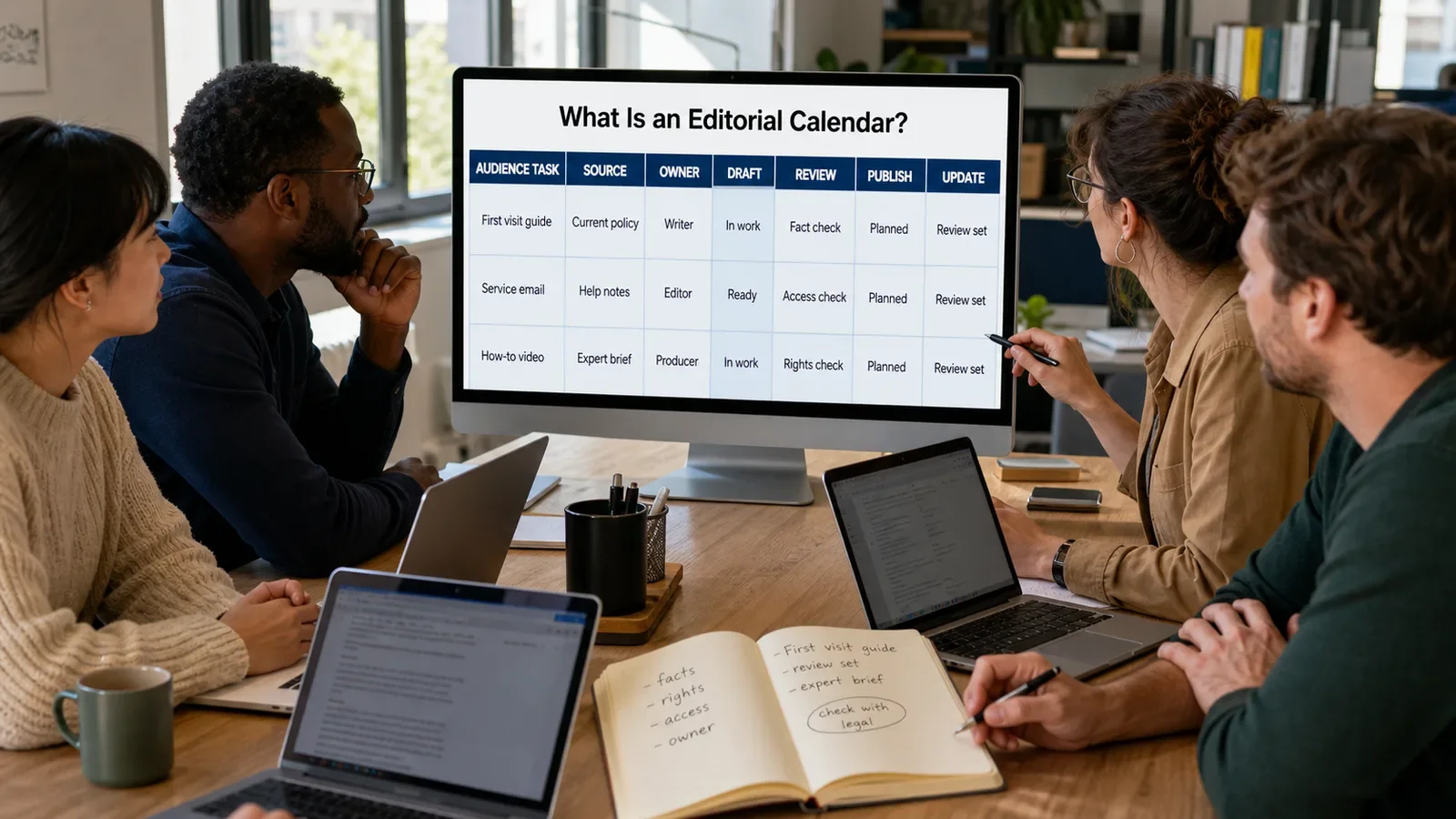
An editorial calendar is a working plan for creating, reviewing, publishing, distributing, updating, and retiring content. It connects each item to an audience need, strategic role, owner, source, format, channel, date, and review path.
It is more than a list of post dates. A publishing schedule says when something goes live. An editorial calendar explains why the item exists and how the team will make and maintain it.
Put It in Plain Words
A team has many ideas. The plan turns the right ones into work with an owner and date.
Each row should say who needs the page, what task it helps with, what proof it needs, and who will write and check it.
Pick the form and place after the need is clear. One idea may be a web page, email, film, live talk, or no work at all.
Plan for the time and skill the team has. A list with more work than the team can make and check is not a plan.
Leave room for change. News, rules, facts, and needs can shift. Write why a date or scope moved.
Plan for a later check and end date. An old page can cause harm even if it did well when new.
Check the whole flow, not just how much went live. Ask if the work is useful, sound, easy to use, and still true.
Start with one page. Name the person and task. Write the one thing the page must make clear.
Name who has the facts. Ask them what source to use and how old that source may be.
Pick one writer and one lead who can say yes or no. Too many vague owners can stop the work.
Set a date for the first draft. Set a new date for fact checks, rights, access, and the final sign-off.
Add the go-live date only when the team has time for each check. Do not plan from the end and hide the work.
Write where the page will be shared. A page with no path from the site may be hard to find.
Set a date to check it once more. Name what could make it wrong, old, or unsafe before that date.
Make one row for a fix as well as new work. The best next task may be to mend a page that people use now.
Keep a “do not make” list. Add weak ideas, close copies, and work with no sound source.
At the team meet, ask three things: What is late? What has changed? What should stop?
Move or cut work in the open. A full grid is not the goal. Good work that the team can stand by is the goal.
After the page goes live, log what you learned. Do not use one high view count as proof that the plan was right.
How Does Editorial Calendar Work?
The team starts from documented goals, audiences, research, journeys, existing content, gaps, obligations, and capacity. It selects items, assigns roles, identifies dependencies, and places realistic dates across creation, review, publication, distribution, and maintenance.
The calendar is used in recurring editorial review. Owners update status and risks. New requests are compared with priorities and capacity. Completed work feeds the next planning cycle rather than becoming proof that the same topic should be repeated.
Why Is It Important?
A clear calendar can reduce missed reviews, duplicate topics, rushed claims, and forgotten updates. It helps writers, experts, designers, legal reviewers, publishers, and channel owners see the same work.
A full calendar is not evidence of a good strategy. The team should cancel weak items and protect time for research, accessibility, rights, and correction.
Where Is It Used?
Articles, video, podcasts, email, social, events, reports, and campaigns.
Newsrooms, product education, thought leadership, support, and regulated review.
Localization, translation, distribution, repurposing, maintenance, and retirement.
A Simple Editorial Calendar Example
A clinic education team may plan one page about preparing for a first appointment. The calendar names the patient task, medical reviewer, source date, writer, accessibility check, translation owner, publish date, and six-month review.
It should not schedule medical claims only because a keyword is popular. Evidence and patient safety remain gates.
What Should an Editorial Calendar Include?
Audience task, content role, and working title.
Owner, contributors, reviewers, and approval path.
Sources, rights, evidence date, and risk notes.
Format, channel, language, and accessibility needs.
Draft, review, publish, distribution, update, and retirement dates.
Status, dependency, decision log, and result notes.
How Do You Build One?
Audit current content and obligations.
Choose priorities from research and strategy.
Estimate real capacity and review needs.
Assign owners and dependencies.
Plan creation, distribution, and maintenance.
Review the calendar and remove weak work.
Editorial Calendar vs. Content Strategy
Content strategy defines why content exists, whom it serves, how it is governed, and how it supports the organization. The editorial calendar turns part of that strategy into scheduled and owned work.
A content calendar may be used as another name for an editorial calendar. Some teams use it for channel posts only. Define the fields and purpose instead of relying on the label.
Common Mistakes
Filling every date before checking capacity.
Treating topic volume as audience evidence.
Leaving sources and reviewers outside the row.
Planning publication but not updates or retirement.
Keeping an item only because work has begun.
Frequently Asked Questions
How far ahead should an editorial calendar go?
Plan far enough to manage research, production, review, and distribution. Keep near-term work detailed and later work flexible.
What tool should an editorial calendar use?
Use a tool the team can maintain. A sheet, database, project tool, or CMS can work if ownership, status, dates, and evidence remain clear.
How often should it be reviewed?
Review it often enough to manage active work and changed facts. Many teams use a weekly production review and a monthly or quarterly priority review.
Ground the calendar in The Anatomy of a Content Strategy and use Content Strategy for Better Google Rankings for search architecture decisions.
Need a calendar that includes evidence, ownership, review, and maintenance?
Book a free Brand and Tech Assessment to map the current problem, evidence, constraints, and practical next step.
Sources
- Content Marketing Institute: 7 Steps to a More Strategic Editorial Calendar. https://contentmarketinginstitute.com/content-optimization/7-steps-to-a-more-strategic-editorial-calendar
- Google Search Central: Creating helpful, reliable, people-first content. https://developers.google.com/search/docs/fundamentals/creating-helpful-content