What Is Brand Personality?
Learn how human-like traits shape a brand’s expression, where the idea helps, and why personality should not become a stereotype.

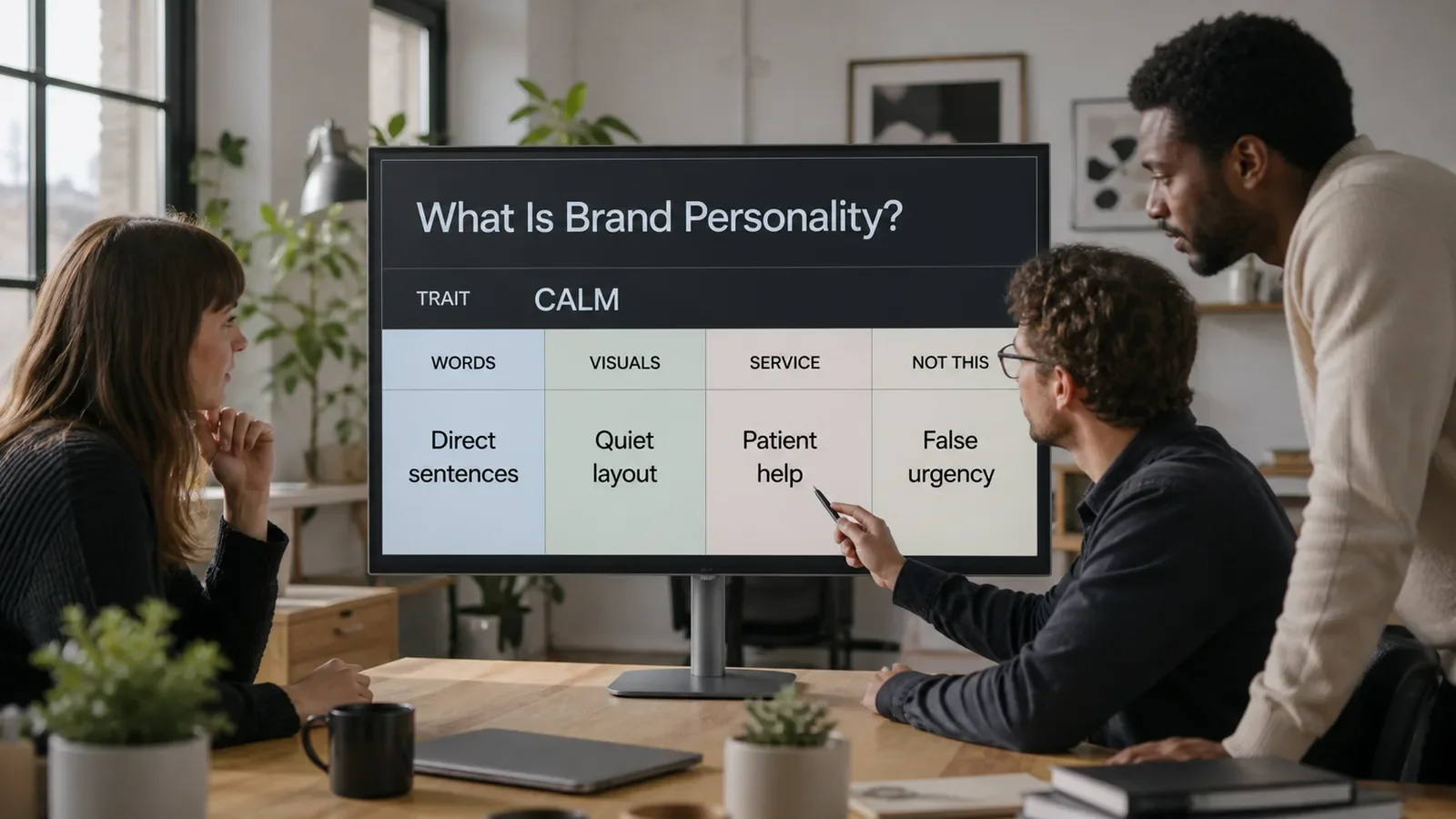
Brand personality is the set of human-like traits people associate with a brand. A brand may feel careful, warm, bold, formal, playful, or direct because of its words, design, behavior, products, service, and cultural setting.
The idea is a planning model, not a fact that the brand is a person. Different people can read the same brand in different ways. Culture, experience, language, and context affect the result.
Put It in Plain Words
People notice patterns. A bank that uses plain language, calm colors, careful service, and clear limits may feel steady. A toy brand with bright movement and jokes may feel playful.
Pick traits that fit the offer and real conduct. A legal service should not call itself warm if the process feels cold and hard to use. Fix the experience before the adjective.
Define each trait with examples. “Confident” may mean direct sentences and clear choices. It should not mean loud claims, pressure, or certainty about a result the brand cannot control.
Also define the edge. A playful brand still needs to be serious about safety, privacy, money, and harm. Personality does not remove duty.
Test the traits with people from the intended audience and with people outside the team. Ask what they saw in actual samples. Do not tell them the answer first.
A useful personality is flexible. The same brand can sound calm in a complaint and more lively in a launch. The core traits stay clear while the tone fits the moment.
Try a small card for each trait. Put the trait name at the top. Add three things the brand would do. Add three things it would not do.
Now give the cards to a writer and a service lead. Ask each person to make one sample. Compare the work. If the samples have no clear link, the guide needs more help.
Use real tasks in the test. Write a price note, a late reply, a welcome line, and a fix for an error. These moments show if the traits can guide the team.
Keep a short list of words to use with care. Do not ban a word just to sound strict. Show the aim and the reason. This helps people make a sound choice.
How Does Brand Personality Work?
A team gathers brand samples, customer language, service behavior, founder intent, and competitor patterns. It proposes a small set of traits, then defines how each trait appears in copy, visuals, motion, sound, support, and product use.
Research can test whether people perceive the intended traits. Jennifer Aaker’s widely cited 1997 study developed one five-dimension scale in a United States setting. It is a research model, not a universal rule for every culture or brand.
Why Is It Important?
Personality can help many creators make choices that feel related. It gives voice, design, content, and service teams a shared way to judge whether an expression fits.
It can harm when traits rely on age, gender, race, class, disability, or cultural stereotypes. Use behavior and evidence. Do not build a fake person and assume a whole audience will respond in one way.
Where Is It Used?
Voice and tone, visual identity, motion, sound, packaging, and campaigns.
Product writing, sales, onboarding, support, and service recovery.
Creative briefs, design systems, training, and brand reviews.
A Simple Brand Personality Example
A financial planning tool may choose “calm, clear, and respectful.” Calm can mean no flashing urgency. Clear can mean plain fee and risk language. Respectful can mean choices without shame or pressure.
The team should test real screens and calls. If users still feel rushed or confused, the traits are not yet present in the experience.
What Should a Personality Guide Include?
Three or four distinct traits.
A plain definition for each trait.
Examples of behavior, words, visuals, and tone.
A “not this” edge that prevents misuse.
Context rules for serious, routine, and celebratory moments.
Research notes, cultural limits, and review dates.
How Do You Define Brand Personality?
Collect real brand and customer samples.
Mark repeated traits and conflicting signals.
Choose a small set that fits the offer and position.
Define each trait through observable choices.
Test unlabelled samples with intended users.
Revise the system when perception and intent do not match.
Brand Personality vs. Brand Voice
Personality is the wider set of traits people may associate with the brand. Voice is how the brand tends to use language. Tone is how that voice adapts to a specific moment.
Brand identity is broader. It includes strategy, name, symbols, design, behavior, and other signals. Personality is one lens within that system, not the whole brand.
Common Mistakes
Picking traits because they sound attractive.
Using stereotypes as a shortcut.
Writing five synonyms that do not guide a choice.
Ignoring service and product behavior.
Keeping one cheerful tone during harm, grief, or complaint.
Frequently Asked Questions
Can a brand have more than one personality?
A brand can show different facets by context, product, or audience. Keep the core coherent and explain the relationship instead of creating random characters.
Is brand personality the same as a buyer persona?
No. Brand personality describes traits associated with the brand. A buyer persona is a research-based model of a customer type and should not be treated as a real individual.
How do you measure brand personality?
Use interviews, surveys, sample comparisons, and behavior data suited to the decision. State the culture, sample, method, and limits of any scale.
Connect personality to language with Brand Voice in a Local Market, and ground it in Brand Positioning.
Need a personality system based on real behavior, not adjectives?
Book a free Brand and Tech Assessment to map the current problem, evidence, constraints, and practical next step.
Sources
- Aaker: Dimensions of Brand Personality, Journal of Marketing Research. https://journals.sagepub.com/doi/10.1177/002224379703400304
- University of Washington: Brand Archetypes dissertation and empirical review. https://digital.lib.washington.edu/researchworks/items/c15713ba-a19c-4da6-9ca8-2758d42560e1