What Is Market Segmentation?
Learn how market segmentation groups people by useful differences, how a segment is tested, and why a label is not the same as evidence.

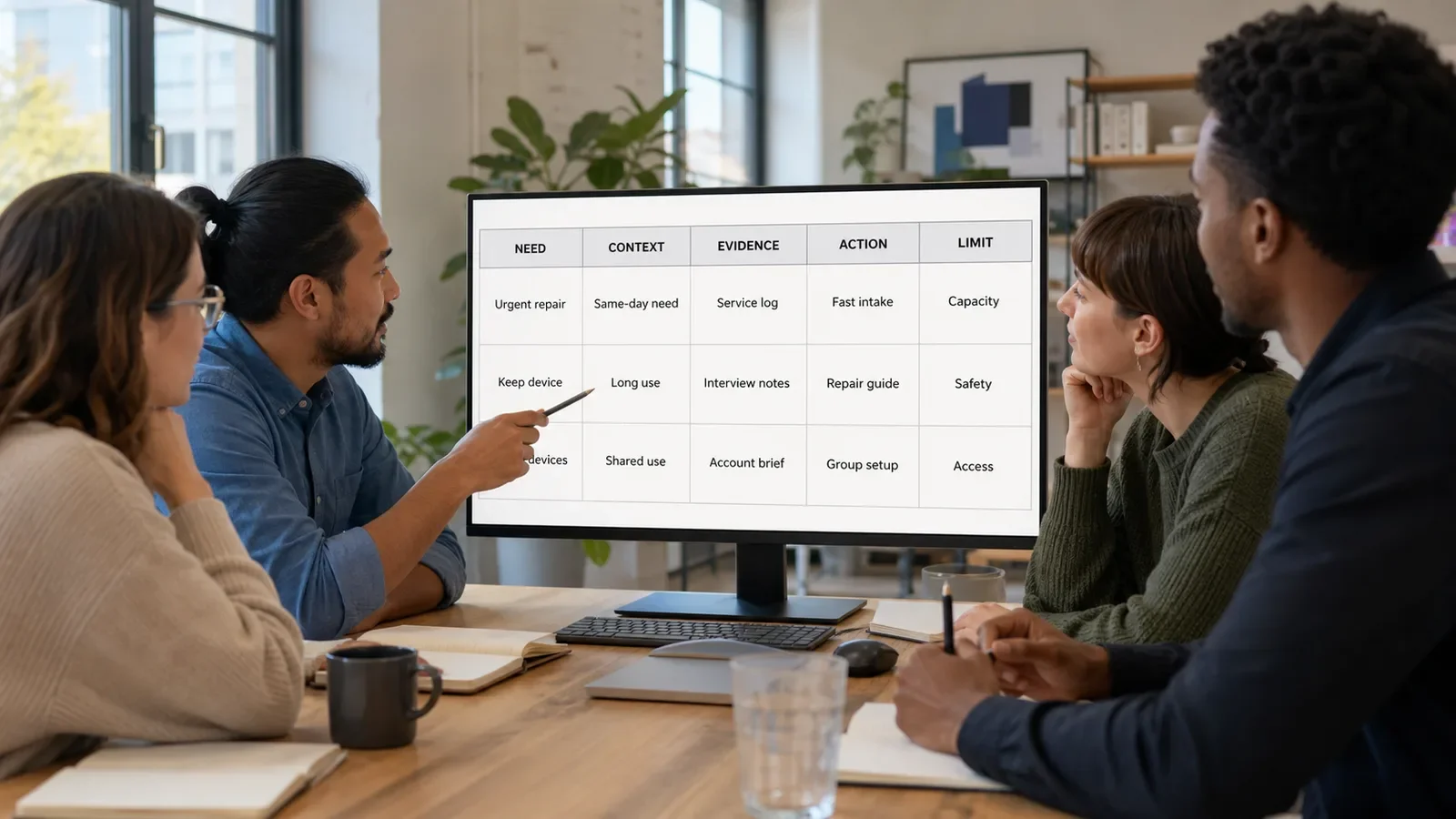
Market segmentation is the process of dividing a broad market into groups whose members share a relevant need, situation, behavior, constraint, or response. A business uses the groups to make choices about offers, service, channels, messages, and research.
A segment is not a stereotype or a list of people who look alike. It should explain a difference that matters to the decision. The group also needs to be identifiable, reachable in a fair way, large or valuable enough for the task, and possible to serve.
Put It in Plain Words
Imagine a repair shop. Some customers need an urgent fix today. Some want to keep an old device working. Some manage many devices for a company. Those needs may call for different service paths.
Age alone may not explain any of those jobs. A group becomes useful when the difference changes what the shop should do.
Start with a question. Which people have a different need, barrier, buying process, or use case? Collect evidence before naming the group.
Use more than one source. Talks can explain why. Sales and help logs can show a trend. A count can show size. Each source has limits.
Write the group in plain terms. State the need, place, proof, and edge. Do not use a tag that says how each person will act.
Test if the team can reach and serve the group. If the group does not change an offer or step, it may have no use.
Review the groups with time. Needs, rules, tools, and places can change. The map is a work aid, not a fixed fact.
Take one real case. Write the need at the top. Name the people who share it. Then list what the team would change.
Now hide the group name. Can a new team member use the facts and reach the same choice? If not, the rule needs more work.
Try the rule on past cases. Note the ones that do not fit. Do not force them into the neat box.
Ask what could cause harm. Check if the data is fair to use. Drop a field when the choice does not need it.
Show the plan to people who know the work. Ask what is false, vague, or left out. Fix the map before you spend.
How Does Market Segmentation Work?
A team defines the market and the decision it needs to make. It gathers customer, buyer, service, product, and market evidence. It looks for meaningful differences, drafts groups, and checks whether each group is distinct enough to guide action.
The team then chooses which groups to serve and how. It may adapt the offer, channel, content, support, price structure, or timing. Results should be compared with the original evidence. A weak segment is revised or removed.
Why Is It Important?
Segmentation can help a team stop treating a broad market as if every person has the same need. It can improve research, planning, service design, and the fit between an offer and a situation.
Poor segmentation can exclude people, waste budget, or turn a loose correlation into a harmful assumption. Sensitive traits require legal, ethical, privacy, and fairness review.
Where Is It Used?
Market research, offer design, product planning, and service models.
Audience selection, media planning, sales territories, and channel choice.
Messaging, content, onboarding, support, retention, and measurement.
A Simple Market Segmentation Example
A training provider may find three use cases: people changing careers, employers training a team, and experienced workers renewing a required credential. The groups differ by buyer, time pressure, proof needed, and support.
The provider should test those differences with real records and interviews. It should not assume that every person in an age group shares one use case.
What Makes a Segment Useful?
A defined market and decision.
A relevant shared need or situation.
Evidence and a clear boundary.
A practical way to identify and reach the group.
An offer or action the team can support.
Privacy, fairness, and review limits.
How Do You Build Segments?
Define the decision before collecting fields.
Gather qualitative and quantitative evidence.
Group by relevant differences, not convenient labels.
Check size, access, service ability, and overlap.
Test the groups in a small plan.
Review outcomes and revise the model.
Market Segment vs. Target Market
A market segment is one evidence-based group within a broader market. A target market is the group or set of groups a business chooses to prioritize. Segmentation describes options; targeting makes a choice.
A buyer persona is a research summary that helps a team understand a type of buyer or user. A persona may represent part of a segment, but a fictional profile does not prove that the segment exists.
Common Mistakes
Starting with a demographic field instead of a decision.
Treating correlation as a fixed trait.
Creating groups the business cannot reach or serve.
Using private or sensitive data without a valid basis.
Keeping a segment after the evidence changes.
Frequently Asked Questions
How many market segments should a business have?
There is no universal number. Use the smallest set that explains meaningful differences and supports clear action without hiding important variation.
Can one person belong to more than one segment?
Yes. A person can have several roles or needs. Define how overlap will be handled instead of forcing every record into one box.
Is market segmentation only for advertising?
No. It can guide products, service, distribution, research, support, sales, and operations as well as communication.
See How to Segment Your Email List for one channel-specific use, and use How to Get More Qualified Leads to connect fit rules with intake.
Need segments that guide real choices without reducing people to labels?
Book a free Brand and Tech Assessment to map the current problem, evidence, constraints, and practical next step.
Sources
- U.S. Small Business Administration: Market research and competitive analysis. https://www.sba.gov/counseling/plan-your-business/#market-research
- Wendell R. Smith: Product Differentiation and Market Segmentation as Alternative Marketing Strategies. https://doi.org/10.1177/002224295602100102