What Is Repetition in Design?
Learn how repeated visual, structural, verbal, and functional patterns build recognition, and how planned variation, states, testing, and ownership keep them useful.

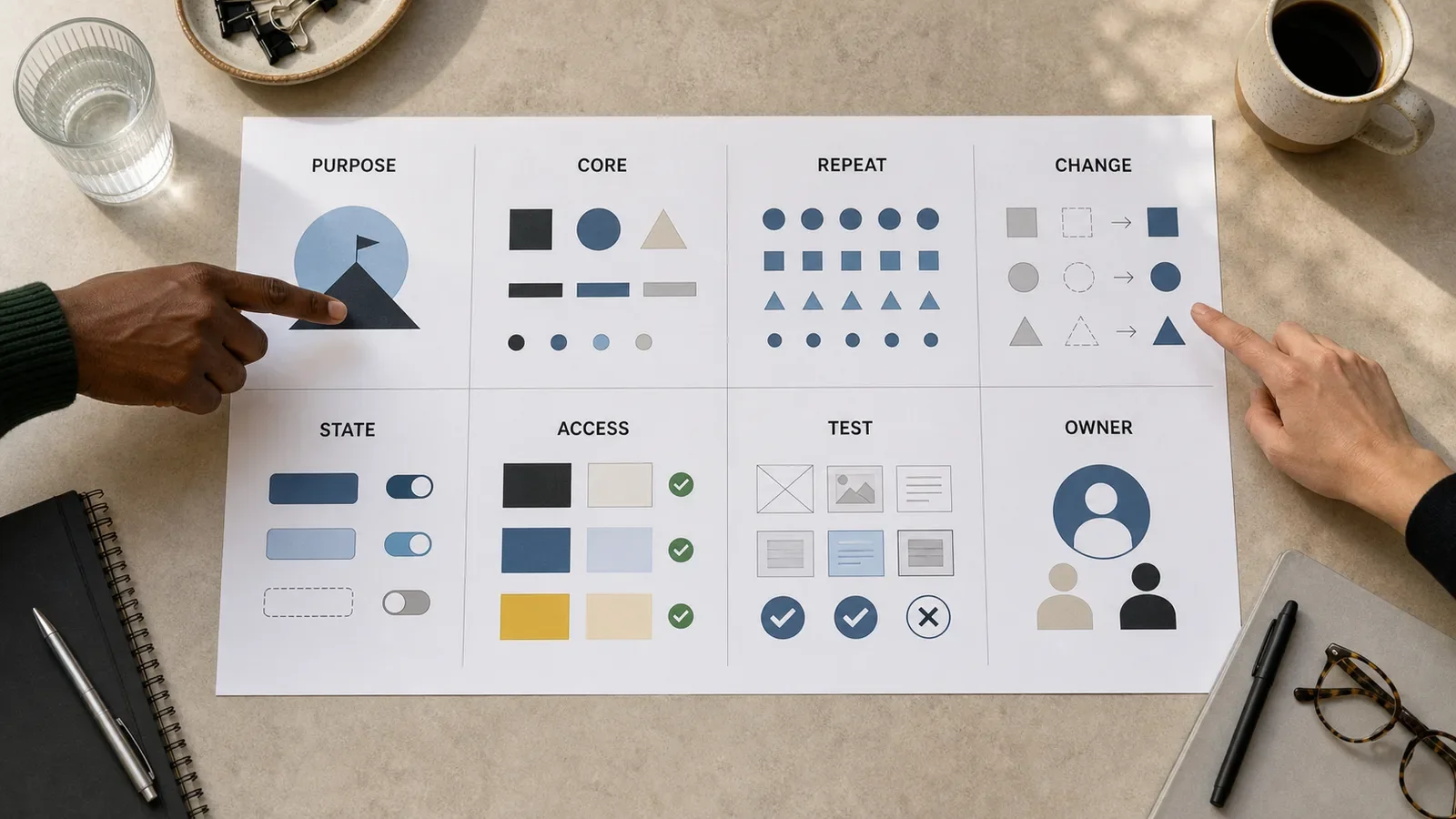
Repetition in design is the planned use of the same visual or structural parts. A team may repeat type styles, spacing, colors, shapes, icons, layouts, controls, or content patterns.
A good repeat gives people a pattern they can learn. It does not mean that every item must look the same in every setting.
Put It in Plain Words
A repeated heading style tells readers where a new section starts. A repeated button style helps them spot an action. A repeated card layout helps them compare one offer with the next.
The repeat needs a job. If a shape returns only because the template has room for it, the shape may add noise instead of meaning.
Stable Core, Planned Change
Start by naming what must stay fixed. A service card may always show a service name, one-line scope, audience, and next step in the same order. The text and image can change while the reading path stays stable.
Then name what may vary and why. A warning can share the base shape and spacing of other alerts, yet use a clear label, icon, and tone. That is planned variation. It helps the warning belong to the system without hiding its risk.
A simple pattern note can use three columns:
Keep: The parts that make the item known.
Change: The parts that respond to content, state, or setting.
Never: Changes that would hide meaning or make two acts look the same.
This small map is often clearer than a long style rule with no real examples.
Repetition Is More Than Decoration
Design can repeat at several levels:
Visual: Type, color, shape, line, image style, and spacing.
Structural: Grids, card order, page sections, and form groups.
Functional: The same control, label, or cue for the same act.
Verbal: The same term for the same idea or action.
Behavioral: The same response, state change, and way back.
These levels need to agree. A set of buttons may look alike but use three labels for the same act. A form may use the same layout while errors appear in a new place on each page. The surface repeats, but the experience still drifts.
Repetition, Consistency, and Rhythm
Repetition is the reuse of a specific element or pattern. Consistency is the wider quality of making related choices agree across a system. Rhythm is the pace created by repeated and varied elements across a layout or sequence.
The terms overlap, but they are not equal. A page can repeat a purple circle in every section and still use mixed labels, spacing, and control behavior. It has repetition without a coherent system.
Nielsen Norman Group's consistency guidance notes that people bring habits from other sites and tools. Internal patterns help, but they should not fight a well-known convention without a good reason.
Repeat Function With Care
On the web, repeat is not only a matter of style. The W3C explanation of consistent identification says that parts with the same function should be named in a way people can recognize across a set of pages.
That does not require exact copies in every setting. A label can change when the context calls for it, as long as people can still tell that the control does the same job. The reverse also matters: controls that do different things should not look or sound so alike that people confuse them.
Check the full state set, not just the resting view. For a control, that may include rest, hover, focus, press, wait, success, error, and disabled states. Color alone should not carry the change. Labels, shapes, icons, borders, or text can add the cue.
Test the Pattern With Real Content
Perfect sample text can hide a weak repeat. Test the pattern with a short name, a long name, no data, an error, a warning, a next step, and translated or right-to-left text when those uses are in scope.
Also test the real places where the pattern will live:
A wide screen and a narrow phone.
Normal text and zoomed or large text.
Light and dark themes when both exist.
A quiet page and a dense page.
Keyboard use and a screen reader where the part is interactive.
Look at the set from far away. Related items should feel linked, and one item should not pull focus by chance. Then read each item up close. A shared look must not make two different actions seem equal.
The U.S. Web Design System asks teams to start with real user needs and test with real people. A repeat that feels neat in a file is still unproven until people can use it in context.
A Plain Service-Card Example
A service site uses one card pattern. Each card shows the service name, short scope, audience, and next action. Readers learn where each fact sits, so they can scan several cards with less effort.
One card covers an urgent legal or safety notice. It keeps the type scale and base spacing, but adds a direct warning label and stronger emphasis. The change has a named reason. It is not a random exception.
The team records both cases: the normal card and the warning card. A real pair teaches the rule faster than a note that says "keep it consistent."
Build and Govern the System
Begin with an inventory of repeated parts in real work. Group only the items that serve the same task. Define the smallest useful core, then list states, content rules, allowed changes, and true exceptions.
Move the rule into the place where people work. That may be a brand guide, page template, design token, coded component, or content pattern. Show correct use and misuse. Give the set an owner, version, test date, and change path.
When a new need does not fit, do not hide it as a one-off fix. Ask whether the old rule is too narrow, the new task is truly different, or the proposed change is just drift. Update the shared rule when the evidence supports it.
A repeated flaw is still a flaw. Fix a weak source pattern before it spreads through more pages, posts, packs, or screens.
Common Mistakes
Repeating a shape with no clear purpose.
Forcing one pattern onto tasks that are not alike.
Making every item so similar that states become hard to tell apart.
Testing the style with sample text but not real content.
Copying a weak or hard-to-use part across the whole system.
Letting exceptions grow without an owner or rule.
Frequently Asked Questions
Is repetition always good?
No. It helps when a pattern supports recall, learning, comparison, or care of the system. Unneeded repeat can add noise or make distinct things hard to tell apart.
Can a repeated system include variation?
Yes. Variation can show state, priority, category, content, or setting. The reason and limits should be clear, and the stable core should still be easy to recognize.
How do you test repetition?
Check whether people recognize the pattern, predict how it works, and notice valid changes. Test real content, states, screen sizes, zoom, keyboard use, and other access needs that apply to the part.
Use How a Design System Actually Works for reusable product patterns and Visual Identity vs. Brand Identity for the wider brand system.
Need a repetition system that improves recognition without copying weak patterns or erasing useful differences?
Book a free Brand and Tech Assessment to map the current problem, evidence, constraints, and practical next step.