What Is User Research?
Learn how user research studies people, needs, tasks, context, barriers, and existing behavior through ethical planning, recruitment, evidence, and analysis.

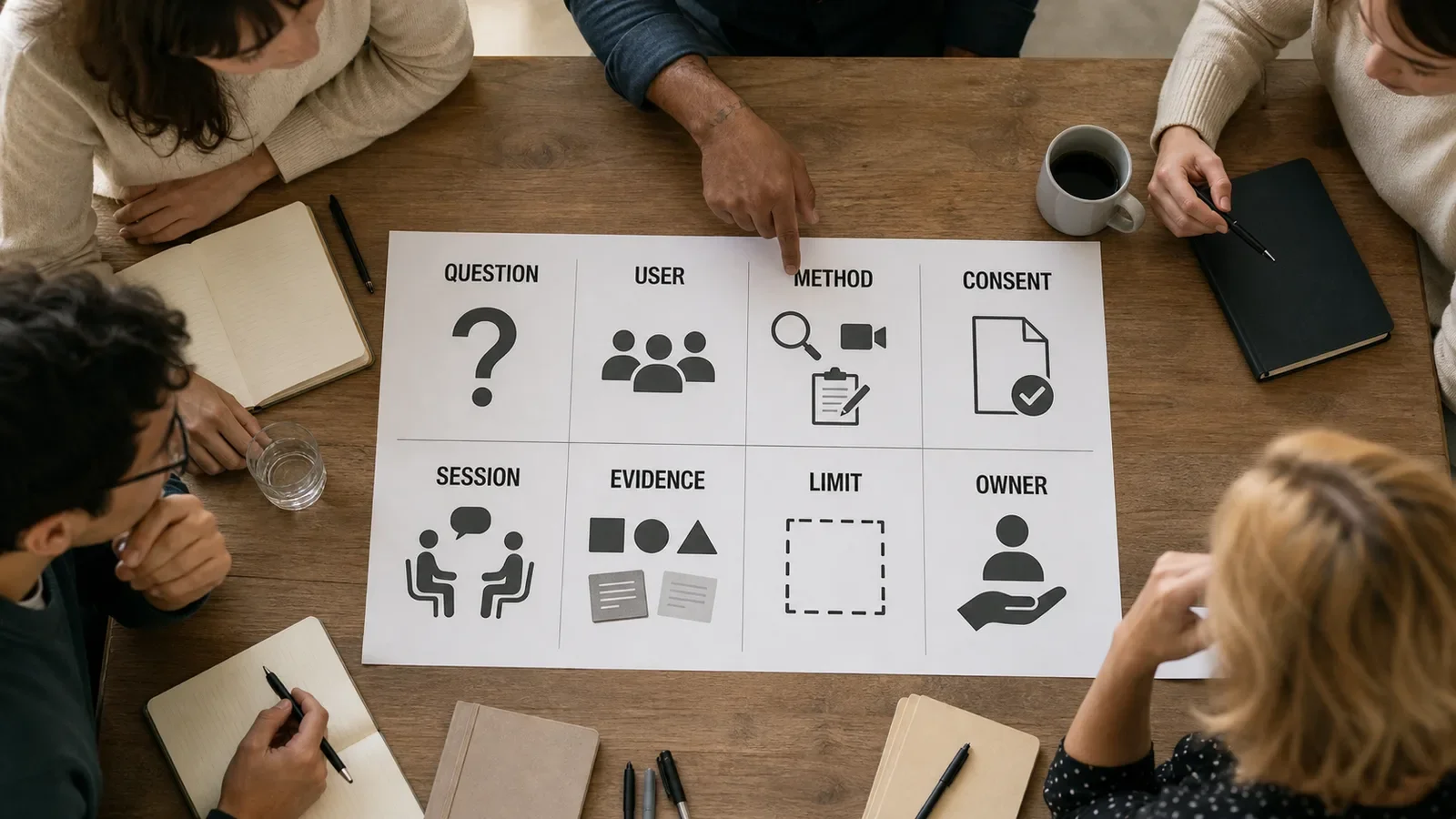
User research is the planned study of people who use, may use, support, or are affected by a product or service.
It helps a team understand needs, tasks, context, behavior, barriers, language, and current work. It uses evidence from people rather than relying only on assumptions or stakeholder preference.
Put It in Plain Words
A plan starts with a clear ask and a choice the team needs to make.
The people in the study should fit the groups who use or may be hurt by the work.
Do not use a group that is close at hand as a stand in for all users.
People need plain facts about the study and how their data will be used.
They should know what they agree to, and the team should keep a sound record of that choice.
The way you learn should fit the ask, not just the tool you own.
A talk can show the words, needs, and past acts that shape a task.
A visit can show work that is hard to call to mind or put in words.
A task test can show how a person uses a set site or tool.
A poll can show a broad trend when its asks, group, and limits are sound.
Help logs and site data can add proof, but they may not tell you why.
Notes should show what the team saw and what it thinks that may mean.
Keep odd cases and facts that do not match the main trend.
A small study does not prove that all people act in the same way.
Hard or sad themes need care, safe data, help, and a way to stop.
The work goes on as the site or need shifts. One test is not a seal that lasts for all time.
Start with what you know. Read old test notes, help calls, site data, and past plans. Mark what is fact, what is old, and what is still a guess. This can save time and make the next ask much more clear.
Write one main ask for the next round. It may be: Can a new user find the right form? Do people know what this fee is for? What stops staff from doing this step now? A broad wish to learn about users is not yet a plan.
Name the choice that the work will help. If no choice can change, ask why the study should run. Do not ask people to give time and trust when the team has no path to act on what it learns.
Choose the right people. A site for all may still have groups with very different needs. Think of age, skill, sight, touch, speech, tech, place, stress, cost, and the help they can get.
Do not ask for more private facts than the study needs. Set where notes will live, who can see them, when they will go, and how a person can ask about their data.
Make the invite clear. State the time, place, pay, task, tools, and any hard theme. Ask what help the person may need. Give a simple way to say no or stop.
Test the guide with one person first. Check that the asks are clear and do not point to the answer. Check that the task can be done in the time. Fix the guide before the full round.
In a talk, ask for a real past case when you can. What did the person do last time? What led to that choice? What was hard? A guess about the next year is not the same as a past act.
In a task test, give a goal, not the steps. Let the person try. Watch what they do and say. Do not teach the path as you test it. Help only when the plan says you should.
Write what took place. A note such as user was lost is a view. A note such as the user read the head twice, chose Back, and said they did not know the fee is more clear.
At the end of each day, share what the team saw. Do not wait for a large deck. Staff who watch the work can help spot a bad guess and act on a clear fault soon.
When you group notes, keep the source near the claim. State how many people were in the round and who they were. Do not turn one quote into a fact about the whole world.
A finding should name the proof, the group, the task, and the limit. It can lead to a change, a new test, or a choice to keep the work as it is. All three can be sound.
Share what you still do not know. A good report does not hide doubt. It helps the team choose the next safe step and stops a small set of facts from being used for a claim they cannot bear.
Keep a plan for what comes next. The team may need to test the new flow, speak with a group that was missed, or check the live site. The next round should build on the last one, not start from scratch.
A Quick Check Before You Use It
Name the research question and the decision it informs.
Recruit relevant people, including those who may be excluded.
Choose a method that can answer the question.
Plan consent, privacy, access, safety, storage, and deletion.
Record evidence, limits, open questions, and an accountable owner.
How Does User Research Work?
Teams define what they need to learn, review existing evidence, choose participants and methods, prepare materials, and complete ethical and privacy checks. They then run sessions and capture evidence.
Findings are analyzed across sessions and shared with the whole team. The result should change a decision, reveal a gap, or state that more evidence is needed. Raw quotes alone are not analysis.
Why Is It Important?
User research can reveal needs and barriers that internal teams do not see. It helps reduce the risk of building around an imagined user, an easy case, or one loud stakeholder.
It also keeps design, content, policy, and service decisions connected to evidence. Research informs judgment; it does not remove the need for legal, technical, operational, and accessibility review.
Where Is It Used?
Discovery, strategy, and problem definition.
Content, service, product, and interaction design.
Prototype and usability testing.
Accessibility, inclusion, support, and policy work.
Live-service monitoring and continuous improvement.
A Plain User Research Example
A clinic wants to change online booking. The team speaks with new and returning patients, people using assistive technology, reception staff, and people who abandoned the current path.
The research finds different needs at several steps. The team records the evidence and limits, then tests a revised flow instead of claiming one session proved the final answer.
What a Research Plan Needs
Question, decision, scope, existing evidence, and assumptions.
Participant groups, recruitment, inclusion, and access needs.
Method, guide, tasks, materials, location, and equipment.
Consent, privacy, safety, incentives, storage, and deletion.
Analysis method, outputs, limits, owner, and next decision.
How to Run a Round of Research
Define the decision and the smallest useful research question.
Review evidence and recruit a suitable range of participants.
Prepare and pilot the method, consent, access, and safety plan.
Run sessions, capture evidence, and protect participant data.
Analyze patterns and differences, share limits, and act on findings.
User Research vs. Market Research
User research often studies how people understand, use, or experience a specific product or service. Market research often studies demand, segments, competitors, attitudes, and buying conditions.
The fields overlap, but neither result should be used outside its sample, method, and question without care.
Common Mistakes
Recruiting coworkers or current fans as the only participants.
Asking leading questions that reveal the preferred answer.
Treating preference as proof of behavior or task success.
Collecting sensitive data with no clear need, owner, or deletion plan.
Reporting one quote as if it represents the whole audience.
Frequently Asked Questions
Is usability testing user research?
Yes. Usability testing is one user research method used to study how relevant people use a defined design, product, or service.
How many people are needed?
There is no universal number. It depends on the question, method, user groups, risk, variation, and decision. State what the study can and cannot support.
Can analytics replace user research?
No. Analytics can show events and patterns. Research can explore context, understanding, barriers, and reasons that event data alone may not reveal.
Use UX Design Services for the wider design practice and Building an MVP That Scales for research-informed product decisions.
Need research that starts with a real decision, includes the right people, protects participants, and produces evidence your team can use?
Book a free Brand and Tech Assessment to map the current problem, evidence, constraints, and practical next step.
Sources
- GOV.UK Service Manual: User research guidance. https://www.gov.uk/service-manual/user-research
- GOV.UK Service Manual: User research in discovery. https://www.gov.uk/service-manual/user-research/user-research-in-discovery