Stop Re-Prompting: A Framework for Consistent Avatars
Re-prompting is a symptom of a broken process. If you're manually re-writing prompts every session, every model update, and every new use case, there's a structural fix available to you.

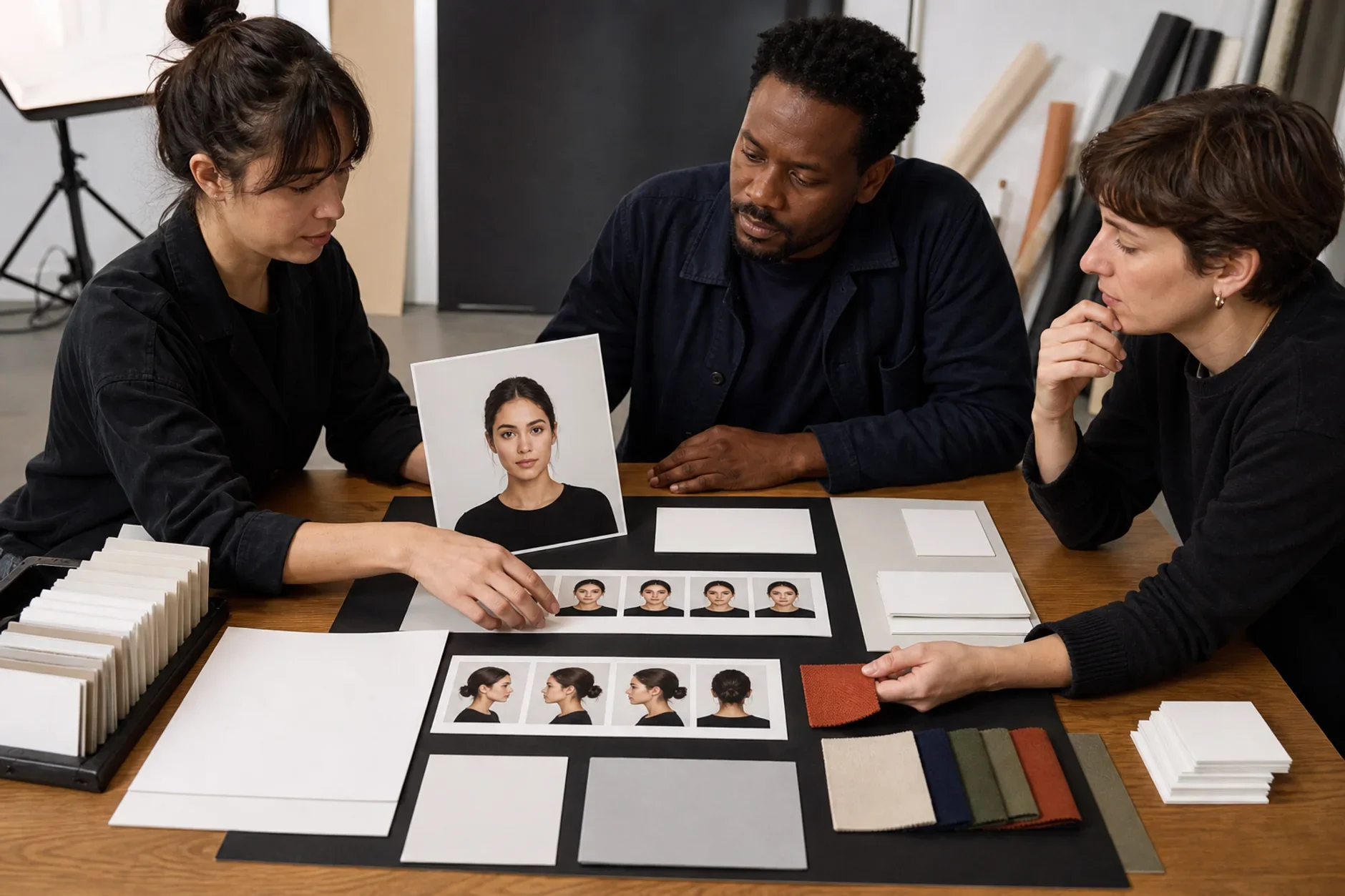
Here is an argument that may feel backwards. If you have worked hard to stop re-prompting AI and get better at prompting, this may surprise you. The goal is not to become a better prompt engineer. The goal is to do good prompting once. You save that work in a reusable structure. Then you apply it the same way every time. You never rebuild it each session. Re-prompting from scratch is not a skill gap. It is a process gap. And the fix for a process gap is a better process. It is not more practice at a slow one.
Here is how most people run AI avatar generation today. You open a model. You write a prompt that roughly matches what you recall from your last good result. You generate a batch. You judge it against your memory of what looks good. You tweak the prompt to fix what went wrong. Then you repeat until the result is good enough. That process wears you out. It gives uneven results. And it starts over fully each time the model updates or you try a new one. The work does not build up. It resets.
The Re-Prompting Trap: Why It Happens
Re-prompting happens for one reason. The knowledge behind your best results sits in the wrong place. Usually it lives in your head. Sometimes it lives in a text file. It never lives in a form that carries to the next session or survives a model update. The knowledge is real. The storage is fragile. Every model has its own prompt language. Each one has its own sensitivities and its own quirks with certain words. A prompt that shines in one model gives a very different result in the next release. The intent did not change. The model's reading of the same words changed. If your process is just a text prompt, it breaks with every model update.
Prompt-as-process breaks on model updates - what worked in March does not work in June
You keep things in your mind. They don’t go to others. Or even to you later. Not after three months.
Re-prompts cause problems. They add drift. You may simplify things too much. Or forget key details. Or remember them wrong. This can mess up a good result.
What a Non-Re-Prompting Process Looks Like
A process that avoids constant re-prompting has three traits. First, it stores the generation settings in a structured form. That form does not depend on any one model's prompt language. Second, the framework handles model-specific translation, so you do not have to. Third, each round starts from your last known-good setup, not from a blank field. These three traits change generation. It shifts from an art form into a manufacturing process. That is not meant to sound cold. It means the results stay consistent and repeatable. They do not depend on who runs the session or which model version is live.
Button-Based Frameworks Are Not Simplifications - They're Encodings
People often push back on button-based frameworks. They say buttons are less flexible than raw prompting. They claim that hiding the prompt costs you control over what you ask for. This mixes up interface with capability. A good button framework does not limit what you can specify. It encodes the translation work, so you never redo it. The buttons stand for real settings. They cover light direction, expression type, wardrobe, and background type. Each button maps to model-ready instructions. Those instructions are already tuned to give the matching result. You still specify exactly what you want. You just do it through settings, not through raw language the model reads.
How Kyndrify Is Built Around This Problem
Kyndrify exists to solve the re-prompting problem at its root. The platform does not just add buttons for ease. It puts all the underlying models behind one unified button-based framework. So when a new model arrives, you do not have to learn how to talk to it. You pick your settings. The framework handles the model-specific translation. Your setup carries over. Say the old model gave a great result from a certain set of choices. The same choices on the next model give a result that stays on track. That works because kyndrify.com keeps the link between settings and model behavior across updates. That is the core value. You get consistency and repeatability by design. You do not have to fight for it through manual re-prompting every time something changes.
Stop chasing better prompting. Start building the right setup. This makes good results repeatable. It cuts out the extra work of prompting. The models are already powerful enough. What was missing is a middle layer. This sits between the models and the users. A button-based framework fills that gap. Right now, most people fill it with time. They also use frustration. The results are often uneven.
Sources
TTGC / Kyndrify - patterns from building AI avatar tooling.
Stanford Human-Computer Interaction Group - research on interface abstraction and creative output quality. hci.stanford.edu
Gartner - research on enterprise AI tooling adoption patterns. gartner.com
Ready to work with Through The Glass Creatives?
Book a free Brand and Growth Assessment. See exactly how the TTGC team would approach it.
Related reading: The 5-Step Framework to a Realistic AI Avatar. Check out this guide. It has five steps. They help you make a realistic AI avatar. Why Clicking Buttons Beats Prompt Engineering for Avatars is another good read. It explains why clicking buttons works better than prompt engineering. This is for avatars.