What Is a Pillar Page?
Learn how a pillar page gives a useful broad answer, connects deeper pages, and differs from a long article, landing page, hub, or doorway page.

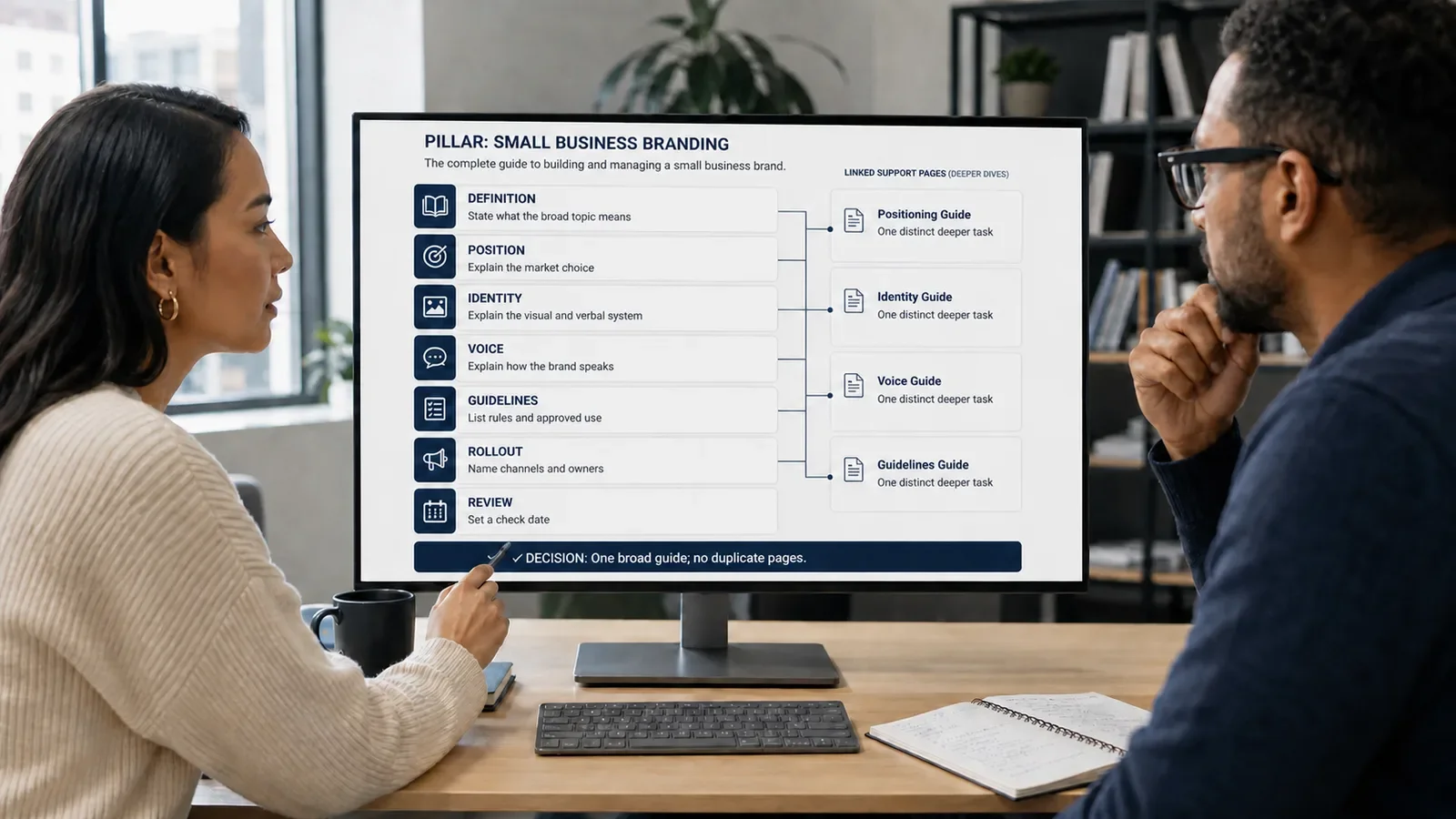
A pillar page is a broad, useful page that introduces a major topic and guides readers to deeper pages about its important subtopics. It often sits at the center of a topic cluster and links to the supporting content in clear context.
A pillar page is not strong because it is long. It should answer the main need, explain the topic map, and help people choose the right next page. It must stand on its own rather than acting as a thin list of links.
Put It in Plain Words
Think of a good book guide. It tells you what the main theme means, shows its key parts, and points to the right book for more depth.
Pick a theme that needs more than one page but still has one clear group and task.
Check what the site has now. A strong guide may be the right hub. Do not make a copy just to fit a chart.
Write the main answer first. Give each key part enough help. Link to a deep page when it adds real use.
Use clear heads, link text, and order. A reader should not need to know the site map to use the page.
Link deep pages back when the hub helps. The same exact link words are not a rule, and forced text can make the work worse.
Keep the page up to date. Add, join, move, or cut links as the theme and site change.
Draw the broad theme in the middle of a sheet. Put each real task around it.
Now match each task to one live page. Mark a gap only when no page gives a good answer.
Open the hub as a new reader. Can you learn the main idea and pick a next path with no guess?
Open each deep page. Does the link back help at that point? If not, do not force it.
Check for two pages with the same job. Pick one to keep. Plan a merge or safe move for the rest.
How Does Pillar Page Work?
The team defines a broad audience task, audits existing pages, maps important subtopics, and chooses a canonical central page. It fills gaps only where a distinct page is useful. The pillar explains the broad topic and links to deeper content in context.
Navigation, breadcrumbs, related links, and contextual links can support the structure. Search engines may use links and site structure to understand relationships, but a pillar model does not guarantee indexing, sitelinks, ranking, or traffic.
Why Is It Important?
A good pillar page can make a large subject easier to explore and show where deeper answers live. It can also reveal duplicate pages, missing topics, and weak internal paths.
A poor pillar page can become a doorway, keyword list, or content dump. Reader value and canonical clarity come before the shape of the cluster.
Where Is It Used?
Educational hubs, service knowledge, product learning, and resource centers.
SEO content architecture, onboarding, support, and research libraries.
Topics that need one overview plus several distinct deep pages.
A Simple Pillar Page Example
A small-business branding pillar may define positioning, identity, voice, guidelines, rollout, and measurement. It can link to a separate useful guide for each part.
It should not create near-identical pages for every spelling or modifier. One canonical page can answer closely related wording.
What Should a Pillar Page Include?
A defined audience, task, and canonical topic.
A direct broad answer and clear scope.
A logical set of major subtopics.
Useful context before each deeper link.
Navigation, ownership, sources, and update date.
Rules for gaps, duplicates, redirects, and retirement.
How Do You Build a Pillar Page?
Choose a real broad task from research.
Audit current and competing pages.
Map subtopics and search intent.
Select or improve the canonical overview.
Link only to useful distinct pages.
Test navigation and maintain the set.
Pillar Page vs. Landing Page
A pillar page mainly helps people understand and explore a broad topic. A landing page is usually built around a focused campaign or action. One page can support both education and a next step, but the purposes should remain clear.
A content hub may include several pillar pages, tools, filters, or collections. A long-form article is not automatically a pillar page unless it plays the central navigation and topic role.
Common Mistakes
Choosing a topic that is too broad or too thin.
Creating a new pillar when a canonical guide already exists.
Publishing a list of links with little explanation.
Forcing exact-match anchors into every page.
Leaving duplicate or outdated support pages in place.
Frequently Asked Questions
How long should a pillar page be?
There is no required length. It needs enough depth to answer the broad task and enough structure to guide the reader without copying every supporting page.
Does a pillar page rank better?
No format guarantees ranking. Usefulness, access, links, competition, site quality, and search systems all affect visibility.
Can a service page be a pillar page?
Yes, if it provides a useful broad answer and guides readers to distinct deeper resources. Keep commercial intent clear.
See Content Strategy for Better Google Rankings for the wider architecture and Internal Linking for crawlable, descriptive connections.
Need one useful central page instead of a pile of competing articles?
Book a free Brand and Tech Assessment to map the current problem, evidence, constraints, and practical next step.
Sources
- HubSpot: Topic clusters and pillar pages. https://blog.hubspot.com/marketing/topic-clusters-seo
- Google Search Central: Link best practices. https://developers.google.com/search/docs/crawling-indexing/links-crawlable